
Earlier today I met with our HPM fellows for another reflective reading session. Thinking about medicine from the perspective of art and literature is so eye-opening, and one of my favorite narrative medicine activities. Our subject for the morning was French impressionist painter Claude Monet, and a beautiful poem by Lisel Mueller called “Monet Refuses the Operation.” You can read the poem here:
https://www.poetryfoundation.org/poems/52577/monet-refuses-the-operation-56d231289e6db
Most people have heard of Monet, and many will immediately think of his paintings of water lilies at Giverny. But what most people might not know is that Monet suffered from devastating, bilateral cataracts. Monet started painting his famous water lilies in 1899, sixteen years after moving to Giverny. He first developed signs of cataracts sometime between 1911-1914. He died of lung cancer in 1926 at the age of 86.
Monet’s art, painted through the quickly dimming lens of his disease, changed dramatically. His color palette went from vibrant blues and greens to deep reds and yellows. At the time, people thought he was experimenting with style and composition. In reality, he was losing his sight.
Pre-cataract painting (The Water-Lily Pond, 1899):
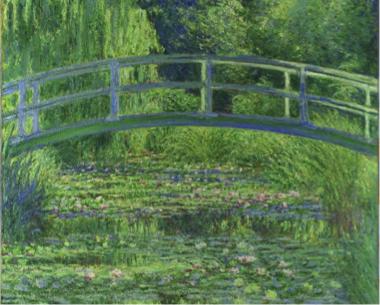
Peak Cataract painting (The Japanese Bridge, Giverny, 1922):

Monet began to despair, labeling his tubes of paint to avoid picking the wrong colors. Everything seemed, to him, a darker shade of the life he once knew. He adamantly refused cataract surgery, which in 1920 was nothing like the procedure today (in fact, to hear it described sounds more than a bit barbaric). And Monet feared, more than anything, an unsuccessful surgery and complete loss of what little sight remained. In fact, similar fates had already befallen fellow painters Honoré Daumier and Mary Cassatt.
Eventually, Monet relented and underwent several operations (after some pressure from French Prime Minister Georges Clemenceau). The post-operative period was a nightmare, and Monet grew to regret the procedures, though with the help of corrective lenses he did regain some sight and a certain sense of color. This led Monet to destroy a number of canvases from his cataract period as he was suddenly able to confirm the betrayal of his eyes and the falseness of the paint.
Monet’s post-cataract paintings did, in fact, return in color to something more familiar. And yet, it is Monet’s collection of cataract paintings that art historians feel link impressionism to modernism, and helped usher in a new era of art.
Post-Cataract painting (Irises, 1923-1926):

There are many wonderful ways to reflect on these paintings and Monet’s struggle with cataracts, as well as the poem by Lisel Mueller and her romantic supposition that perhaps Monet found beauty in the blur. I like to remind myself that sometimes what we see and what our patients see are not always the same, and that what is unappealing or beautiful, acceptable or devastating, is often a matter of perspective and priority.
And that just as no two people are alike, so too are no two palettes.
**Note – if you were wondering, here is a simulation of what ophthalmologists believe Monet’s visual acuity was at the height of his disease, with images on the left being the final painting and right being what he probably saw**

Sources:
Marmor MF. Ophthalmology and Art: Simulation of Monet’s Cataracts and Degas’ Retinal Disease. Arch Ophthalmol. 2006;124(12):1764–1769. doi:10.1001/archopht.124.12.1764
Gruener A. The effect of cataracts and cataract surgery on Claude Monet. Br J Gen Pract. 2015 May;65(634):254-5.
https://www.davisart.com/blogs/curators-corner/claude-monet-cataracts-paintings/
 Moments Matter MD