Moments Matter 70: Two Weeks

It’s been a tough day.

I’ve stared at those words for a while now, unable to write anything after. And while I stared, a day became days, and then a week. And now, it’s been a tough two weeks.

I pride myself in being able to sit with differing opinions, to hold two things in one hand and consider them from all angles, to weigh them both, to see the qualities inherent in both, to imagine a situation in which I might choose the one over the other. It is, after all, what I do most often as a palliative care doctor. It’s how I’ve built my life, and how I’ve raised my kids. But lately, I’ve struggled to see things from both sides.

It’s been a tough two weeks. It’s been tough watching core values, values that guide every passing second of my life, values that shape who I am as husband father doctor human, so brazenly challenged and mocked and torn down.

It’s been a tough two weeks. It’s been tough watching something I’ve dedicated my entire life to – the study of science, the belief that we as people are better for asking hard questions and relentlessly pursuing the truth even if we’re proven wrong – so brazenly challenged with little regard for consequence. It’s been tough watching something I’ve dedicated my entire life to – the empathetic and compassionate treatment of all people – so brazenly challenged. Tough watching violence condoned and bullying lauded.

And now ICE and CBP agents can enter our churches without seeking further authority. And now, too, our hospitals.

I’m all for re-evaluation of policy and restructuring and change, and I’ll be the first to agree that change is needed in our country on many levels and on both sides of the aisle. But not at such a cost, never at such a cost. Never at the cost of sacrificing values that should, and must, be universal. Respect and tolerance and equality and compassion and empathy. Life is not fiction, it is fact. Freedom is not fickle, it is doing and saying and protecting that which makes us all feel free, be free.

All of us. Together.

I’ve struggled internally with whether to post this or not: it has lived as a draft, in one form or another, for two weeks. These thoughts are my own, though I’m comforted knowing that a great many share them. At the end of the day, I reminded myself that I write for my own health, that I write because I must, that it is my way of healing and moving on. And I reminded myself that this is not a political blog, it is a health and wellness blog.

And I reminded myself that this is not a political post, it is a health and wellness post. For me, for my children, for our country, for the world.

Moments Matter 69: The Some-Other Technique

One of my favorite, and most frequently-used, communication skills is what I like to call the “Some-Other” technique. I was on call yesterday at Mercy and probably used this technique five or six times. Some might say I use it too much, others might say I don’t use it nearly enough.

Some-Other is a great way to map someone’s preferences using a focused, and directed, set of choices. It’s also a great way to acknowledge that there’s often no “right” or “wrong” choice, and that it’s ok to feel what you feel and decide what you decide, as long as it’s right for you.

Here’s an example:

“Some people who have survived a stay in the ICU never want to return, even if it means they might die. Others would return to the ICU if recommended by their doctor. What kind of a person are you?”

Of course, we could argue the wording and how to adapt it for different questions, but the concept’s the same. The key to using the Some-Other technique is to never use it in isolation: it’s always helpful to pair it with further exploration and empathetic response. A NURSE statement like “tell me more” is a great one to use after Some-Other because it creates space to explore someone’s rationale for selecting option A or B. Sometimes literally acknowledging that there’s no right or wrong decision, or exploring how hard it must be to think about the question at hand, is also helpful.

Moments Matter 68: The Things to Come

Happy New Year.

We were able to spend a wonderful Christmas with family making great new memories from some really special moments. And now, with one toe dipped into 2025, I find myself so fortunate to stand at the beginning of another year, happy and healthy and ready to face what comes. I know not every year will start like this, so I’m determined to make the most of it while I can.

My year has started off with a bit of reflection courtesy of my son. He’s something of an old soul, prone to nostalgia and intense retrospection. He’s already reminiscing about the good ‘ole days of last week, the time we had that epic air hockey tournament, those amazing dumplings from that Chinese restaurant. Part of this, I know, is to be expected – the dread at the end of Christmas break, the nervous anticipation of the start of school. Part of this is also the 80 year old man trapped in his 12 year old body.

I chuckle as I write this because that’s exactly how I was described as a child. “Mature for his age,” “such an old soul,” “so quiet and brooding.” I don’t think much has changed since then, except that my age is quickly catching up to how I’m expected to behave. I was a brooder. I used to dwell a lot in the past. I used to relive memories, used to wonder what if and who knows and maybe this or that as if thinking hard enough about the past could somehow reshape the present.

I know exactly when my perception changed: it’s when I started working in medicine. I met and cared for so many people who shared so many stories about their lives, so many amazing and wonderful and touching things that it was hard to see anything positive ahead, especially when faced with disease. I worried that spending so much energy mourning what’s left behind leaves so little energy to live the life ahead.

A lot of what I do in palliative care is energy, and priority, redistribution. It’s about identifying what matters most and shunting effort and resources to help find meaning or achieve happiness or restore identity with what time remains. I think what I’ve come to realize over the past 20 years in medicine is that this doesn’t have to be an end-of-life strategy: it can be a life strategy.

All of which is to say: I’ll help my son make the most of these last few days of Christmas Break. We’ll make space for new moments, and new memories whenever and however they appear. And we’ll embrace all the exciting and slightly terrifying adventures ahead.

Here’s to all the magic and wonder and wisdom that awaits us in 2025.

Moments Matter 67: The Use of Silence

The intentional use of silence in conversation is such a powerful tool. It slows things down. It gives room to breath, and emotion time to stretch. But more importantly, it gives space for patients to process things at their own pace.

There’s data to support the use of silence. Studies have shown that time spent talking, and not talking, matters: in fact, when doctors speak less in a family meeting and patients speak more, families perceive the meeting as more satisfying with less conflict. Actual time spent meeting doesn’t matter.1

This is why, when I teach my residents and fellows NURSE statements for responding to emotion with empathy, I teach it as “NURSES” to include the use of silence. The intentional use of silence is an emotional response skill just like any other, and it requires timing and practice, as well as recognition of when to jump back in.

I’ve seen the use of silence work beautifully. One classic scenario is to use silence after an “I Wish” statement. For example:

A: I came here for a cure, there has to be more you can offer!

B: I really wish there was… (silence)…

Silence in this scenario lets your patients to fill the empty space with whatever’s on their mind. This lets you advance the conversation and explore what matters most, knowing what we know. If you find that you’ve been talking for the past ten minutes non-stop in a meeting, then that’s probably nine minutes and thirty-seconds too long. Take a break. Push pause. Your patients, and your lungs, will thank you.

I’ve also seen silence not work. When I was a fellow, I tried using silence with one of my patients, and after a minute she turned to me and asked “Why aren’t you saying anything?” I didn’t try it again.

Silence doesn’t work as a communication strategy for everyone, just as naming the emotion might not work for everyone. But when it works, it’s a tremendously effective way to explore emotion with empathy.

And it shows your patients that you’re listening, and care about what they have to say perhaps more than your agenda or checklist or the next thing you have to do. It’s this sense of genuine concern and compassion that helps shine the clearest light on what matters most for our patients.

Source:

  1. McDonagh, Jonathan R. MD; Elliott, Tricia B.; Engelberg, Ruth A. PhD; Treece, Patsy D. RN, MN; Shannon, Sarah E. PhD, RN; Rubenfeld, Gordon D. MD, MSc; Patrick, Donald L. PhD, MSPH; Curtis, J. Randall MD, MPH. Family satisfaction with family conferences about end-of-life care in the intensive care unit: Increased proportion of family speech is associated with increased satisfaction*. Critical Care Medicine 32(7):p 1484-1488, July 2004.

Moments Matter 66: What We See

Earlier today I met with our HPM fellows for another reflective reading session. Thinking about medicine from the perspective of art and literature is so eye-opening, and one of my favorite narrative medicine activities. Our subject for the morning was French impressionist painter Claude Monet, and a beautiful poem by Lisel Mueller called “Monet Refuses the Operation.” You can read the poem here:

https://www.poetryfoundation.org/poems/52577/monet-refuses-the-operation-56d231289e6db

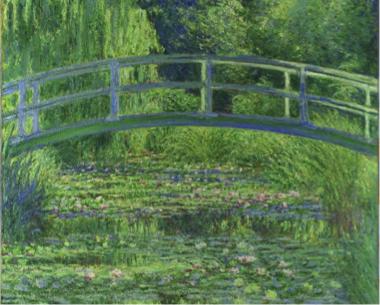
Most people have heard of Monet, and many will immediately think of his paintings of water lilies at Giverny. But what most people might not know is that Monet suffered from devastating, bilateral cataracts. Monet started painting his famous water lilies in 1899, sixteen years after moving to Giverny. He first developed signs of cataracts sometime between 1911-1914. He died of lung cancer in 1926 at the age of 86.

Monet’s art, painted through the quickly dimming lens of his disease, changed dramatically. His color palette went from vibrant blues and greens to deep reds and yellows. At the time, people thought he was experimenting with style and composition. In reality, he was losing his sight.

Pre-cataract painting (The Water-Lily Pond, 1899):

Peak Cataract painting (The Japanese Bridge, Giverny, 1922):

Monet began to despair, labeling his tubes of paint to avoid picking the wrong colors. Everything seemed, to him, a darker shade of the life he once knew. He adamantly refused cataract surgery, which in 1920 was nothing like the procedure today (in fact, to hear it described sounds more than a bit barbaric). And Monet feared, more than anything, an unsuccessful surgery and complete loss of what little sight remained. In fact, similar fates had already befallen fellow painters Honoré Daumier and Mary Cassatt.

Eventually, Monet relented and underwent several operations (after some pressure from French Prime Minister Georges Clemenceau). The post-operative period was a nightmare, and Monet grew to regret the procedures, though with the help of corrective lenses he did regain some sight and a certain sense of color. This led Monet to destroy a number of canvases from his cataract period as he was suddenly able to confirm the betrayal of his eyes and the falseness of the paint.

Monet’s post-cataract paintings did, in fact, return in color to something more familiar. And yet, it is Monet’s collection of cataract paintings that art historians feel link impressionism to modernism, and helped usher in a new era of art.

Post-Cataract painting (Irises, 1923-1926):

There are many wonderful ways to reflect on these paintings and Monet’s struggle with cataracts, as well as the poem by Lisel Mueller and her romantic supposition that perhaps Monet found beauty in the blur. I like to remind myself that sometimes what we see and what our patients see are not always the same, and that what is unappealing or beautiful, acceptable or devastating, is often a matter of perspective and priority.

And that just as no two people are alike, so too are no two palettes.

**Note – if you were wondering, here is a simulation of what ophthalmologists believe Monet’s visual acuity was at the height of his disease, with images on the left being the final painting and right being what he probably saw**

Sources:

Marmor MF. Ophthalmology and Art: Simulation of Monet’s Cataracts and Degas’ Retinal Disease. Arch Ophthalmol. 2006;124(12):1764–1769. doi:10.1001/archopht.124.12.1764

Gruener A. The effect of cataracts and cataract surgery on Claude Monet. Br J Gen Pract. 2015 May;65(634):254-5.

https://www.davisart.com/blogs/curators-corner/claude-monet-cataracts-paintings/

Moments Matter 65: Anticipatory Guidance

Knowing when to explore a little more, and when to slow down or stop entirely, is a subtle communication skill. It’s one that demands patience and a willingness to bend. It requires recognition of many signs, and knowing what to do when you see those signs.

The truth is we’re often pressured to “get more” in medicine: get more information, get more closure, get more agreement with medical recommendations, get more clarity on discharge plans. As clinicians, we certainly feel the pressure of hospital lengths of stay and other statistics; as patients, the medical facts and plans may not always line up with emotional currents.

Recognizing when communication becomes pressured can be challenging. Sometimes there are non-verbal patient signs like breaking eye contact or shifts in body posture (or family members not responding to calls). We may start to feel an internal sense of frustration or judgment, and use labels in response to conflict. It may feel necessary to have a family meeting every day to get our point across.

Initially, the best course of action may be empathetic exploration (ie “It must be exhausting talking about this so often”). But there may come a time when the best course is to acknowledge that we’ve gone as far as we can for now. Shifting into anticipatory guidance and helping your patient think about things to ask in the future can be helpful. Writing down questions for your patient to consider, or talk over with family, is a great strategy. Giving your patient an Advance Directive to review once they get home can also spark important conversations that are too hard, or scary, to have in the hospital. Updating PCPs so they can take the next steps in conversation is also a great idea.

But when all is said and done, I think recognizing that not all situations will have a perfect, neat, satisfying resolution is healthy, and helps set more achievable, humanistic expectations for those of us who practice medicine.

Moments Matter 64: Believe That You Can Learn

Believe, deeply and truly, that you can learn something from every person you meet.

I’ve seen variations on this theme, but they usually involve what others can teach you, which I think puts the emphasis of learning on the wrong person. Some people are teachers whose role is to teach, most people are not. It’s up to us to learn from everyone, regardless.

It doesn’t mean you absolutely will learn something from every person you meet. It might take time, or the lesson might be hidden from sight or you won’t realize it until years later. But believing that you can learn something – that the potential exists and that you welcome it – is key to being a lifelong learner, and to lifelong growth.

Believe, deeply and truly, that you can learn something from every person you meet.

I recently met someone struggling with addiction. I learned that sitting down and maintaining eye contact, not just making eye contact but holding it without breaking, can make someone living a life full of labels and assumptions and judgment feel heard. Feel seen, and respected.

I learned that most people never looked him in the eyes, never shook his hand, never spent more than a few minutes talking to him. I learned that he never realized how much he needed someone to just sit there, and listen, and look him in the eyes while he shared his story.

I learned that he felt, for a moment, connected again to something he assumed was lost forever.

Believe, deeply and truly, that you can learn something from every person you meet.

Moments Matter 63: Be Willing To Bend

Be willing to bend.

Healthcare isn’t a competition. It’s not a contest to see who can change a patient’s mind the quickest, or make someone “get it” the fastest. Medicine isn’t about convincing patients we’re right and they’re wrong.

It’s not about saying “I told you so.”

But this is sometimes how medicine is perceived, and how patients feel after interacting with their medical teams. The most effective medicine I’ve seen always involved negotiation and compromise, always involved finding some kind of middle ground. Perhaps it’s a negotiation between various consulting services or family members, or liberalizing diet restrictions for comfort and dignity knowing that aspiration is a risk.

It’s hard to put medicine into neat, prescribed, compact, rigid packages because at the end of the day, medicine is about people. And people never come in neat, prescribed, compact, rigid packages.

People are lively and chaotic and amazing and messy and sometimes terrified and easily overwhelmed.

And therefore, so is medicine.

Moments Matter 62: It’s Not Just a Matter of Time

I feel like we spend a lot of energy thinking about prognosis in terms of time, but it’s not always a matter of time. In fact, for many of my patients, “how much time do I have left” is often less important than “can I feel, in some way, like myself again?”

This is a pretty well-understood concept in palliative medicine, the concept of quality of time vs quantity of time. And yet, when we discuss prognosis with our patients, we tend to speak in hours to days to months or years – we tend to assume that the most important, or relevant, aspect of prognosis is time.

Reframing prognosis in terms of what matters most is often helpful. Temporal Prognosis may take a back seat to Functional Prognosis, or Identity Prognosis, or Legacy Prognosis. This is something we consider quite a bit in our inpatient rehab and stroke units where physical function and independence are typically affected. A REMAP headline may become less about “time is short” and more about what it is, or is not, possible looking ahead.

And if you’re unsure about which type of prognosis matters most to your patient? Then the best thing to do is explore with empathy and curiosity (an “I wonder” statement may work well here!).

Moments Matter 61: Just a Little Insight

You can’t know what you don’t know. Seems pretty obvious, but it’s something easily overlooked in medical decision making.

We make a lot of assumptions in healthcare, one of the biggest being that our patients can’t possibly understand information the way we do. So we end up talking down to our patients, or using jargon or euphemisms, and when we meet “resistance” to our message, we spiral in frustration and affix labels. In reality, it means we’re probably not communicating with our patients in the most effective, individualized way.

Sometimes this goes a step further. For example, we might assume that a patient with a diagnosis of dementia isn’t capable of understanding medical updates when in reality this is not true. When we go to assess capacity to make a specific decision, the patient might say “I don’t know what’s going on.” If he literally hasn’t been updated because someone with dementia couldn’t possibly comprehend what’s going on, then this could very well be a statement of fact and not a lack of insight.

You can’t know what you don’t know. Your patient may not want to know, and that’s a separate topic. But don’t assume a lack of insight based on bias or perceived “resistance” to your message.

Related: https://jamanetwork.com/journals/jama/article-abstract/2765421